
Linen is made from the fibres found inside the stem of the flax plant (Linum usitatissimum), not the seeds, not the leaves. Those fibres are a bast fibre, made almost entirely of cellulose, which is exactly what gives linen its strength, breathability and famously cool, crisp feel.
Linen's makeup, in short:
- Fibre type: bast fibre, from the plant's stem
- Main component: cellulose (roughly 70%+), plus natural pectin and lignin
- Not related to: cotton (a seed fibre) or synthetic fabrics
- "100% linen" means: pure flax fibre, nothing blended in
- Common blends: linen-cotton, linen-viscose, linen-polyester
What is linen made of? Sunshine, water and a pretty little plant called flax.
(And probably a few other things, but that messes with the rhythm of the sentence.)
The flax plant is pictured above, so you can see that the "pretty" claims come with backup.
And where is the best stuff made? Somewhere you'd definitely want to go on holiday.
Now that we've set the scene, let's get into the details, because there are obviously quite a few missing steps between flax fields and the linen dress hanging in your closet.
We'll get into what's actually in the fibre, where it's grown, how it compares with other natural fabrics, and how to tell the difference before you buy.
Because not everything with a "linen" label is actually flax. Some of it is a very convincing costume.
And we know you're here for the proof that linen is a completely natural fabric. We have high standards too, so of course, we're going to share all the info.
Yes, that little "100% linen" label is trying to tell you something. And it can make a difference to how the linen feels against your skin and how long it lasts.
There are plenty of gorgeous pictures too, because who said education can't be fabulous?
In This Article
The Short Answer · Bast Fibre Family · Where It's Grown · What's In The Fibre · Linen vs Cotton · 100% Linen, Explained · Common Blends · Fabric Weight · Check The Label · Before You Buy · Fibre To Fabric · FAQs

The Short Answer: Linen Is A Bast Fibre
Textiles are sorted into different 'families', and it's worth knowing which one linen belongs to before we go any further.
- Seed fibres: cotton, popped straight off a fluffy seed head.
- Animal fibres: wool, silk (courtesy of sheep and silkworms).
- Synthetic fibres: polyester, nylon (basically plastic wearing a costume)
- Bast fibres: linen (which come from the stem of a plant).
Linen falls into that last camp, alongside hemp, jute and ramie. Cotton fibres can be harvested straight from the plant.
Flax is hiding inside a woody stalk, so it has to be extracted before it can become a fabric.
Which helps explain the higher price tag, and why it hasn't yet been automated (it's not that simple).
How Does Linen Compare To Other Bast Fibres?
Flax isn't the only plant that produces a bast fibre. Hemp, jute and ramie all come from the same family, each suited to different uses.
Hemp is coarser and even more hard-wearing than flax. It's typically used for heavier, canvas-weight fabric rather than clothing.
Jute is too rough and stiff for garments. It's mostly used for sacking, rope and other industrial applications.
Ramie is finer and silkier than flax, but less elastic. Because it doesn't hold its shape as well on its own, it's usually blended with a sturdier fibre.
Linen sits in the middle of the family: refined enough to wear against your skin, but textured enough to still feel like a natural fabric.
Where Does The Flax Actually Come From?
Flax is fussy about where it lives. It wants a narrow window of temperate, damp climate and sulks in heat or drought.
Western Europe (France, Belgium and the Netherlands) produces the world's finest linen.
The fashion world fights over it, thanks to soil and rainfall that make the European fibres longer and cleaner, which equals softer and stronger.
China, meanwhile, grows more flax than anywhere else on earth by sheer volume, usually processed into a coarser, inferior linen.
A little more comes out of Eastern Europe and Egypt, where people have been growing flax since approximately forever.
We get into exactly why the growing region matters this much, and why it changes what you pay, in our deep dive on what is linen.

What's Actually In The Fibre? (Linen's Chemical Makeup)
Let's get technical for a second: crack open a flax fibre and it's roughly 70-75% cellulose, 15-20% hemicellulose, plus a supporting cast of natural pectin, lignin and trace waxes.
Cellulose is the strength: the stuff doing the heavy lifting. The pectin and lignin act like nature's own glue, holding the fibre bundles together, which is exactly why raw flax feels stiff and a little stubborn to begin with.
It's also why linen keeps getting softer every time you wash it, instead of wearing thin the way a synthetic eventually does.
You're not breaking the fabric down, you're just slowly dissolving the plant glue that was holding it rigid in the first place.
Curious exactly how much softer it gets, and how fast? We tracked it wash by wash in does linen soften over time.
Because there's essentially no synthetic anything in that mix, a genuinely 100% linen piece will actually biodegrade when its time comes, the same as any other plant matter left to do its thing.
A linen-polyester blend doesn't get that same happy ending. The polyester portion is plastic, and plastic doesn't much care how long it takes to disappear.
One more reason that little percentage on the tag is worth an actual look.
Is Linen Made From Cotton?
No, and we get asked this more than you'd think. Linen comes from the stem of the flax plant. Cotton comes from the fluffy seed head of an entirely different plant.
Different plant, different fibre, different everything. They just happen to share a shelf in the "breathable natural fabric" aisle.
We go properly deep on this mix-up, and why it happens so often, in our full what is linen guide.

What Does "100% Linen" Actually Mean On A Label?
Labelling isn't just marketing fluff. It's legally required, so brands actually have to tell you what percentage of fibre is in their clothing.
"100% linen" means exactly what it says: every fibre is flax, nothing else sneaking in.
That's what earns pure linen its reputation: the best breathability, the fastest softening, the longest lifespan you'll get out of any linen.
It's also part of why it tends to cost more and wrinkle more than a blend, there's no synthetic filler smoothing either of those over.
That crease-prone reputation isn't a flaw so much as a signature. We break down exactly what to expect, and how to deal with it, in does linen wrinkle.
Curious exactly why that price tag looks the way it does? We break the whole thing down in why is linen so expensive.
Most of what we make stays 100% linen for exactly that reason. But every so often, a tiny amount of something else earns its place, and it's not a downgrade when it does, more on that next.
Common Linen Blends (And Why They Exist)
Not everything labelled "linen" on a rack is actually 100% linen, and that's not always a scandal.
Sometimes it's a trade-off. Sometimes it's actually the smarter choice. Here are the most common blends:
- Linen-cotton: linen usually makes up the majority share, with cotton filling in the rest, exact ratios vary a lot by brand. Softer, cheaper, and less prone to wrinkling than pure linen, at some cost to breathability.
- Linen-viscose (or linen-rayon): linen typically still leads the blend, with viscose smoothing things out. Smoother, it's a big reason your favourite flowy dress moves the way it does.
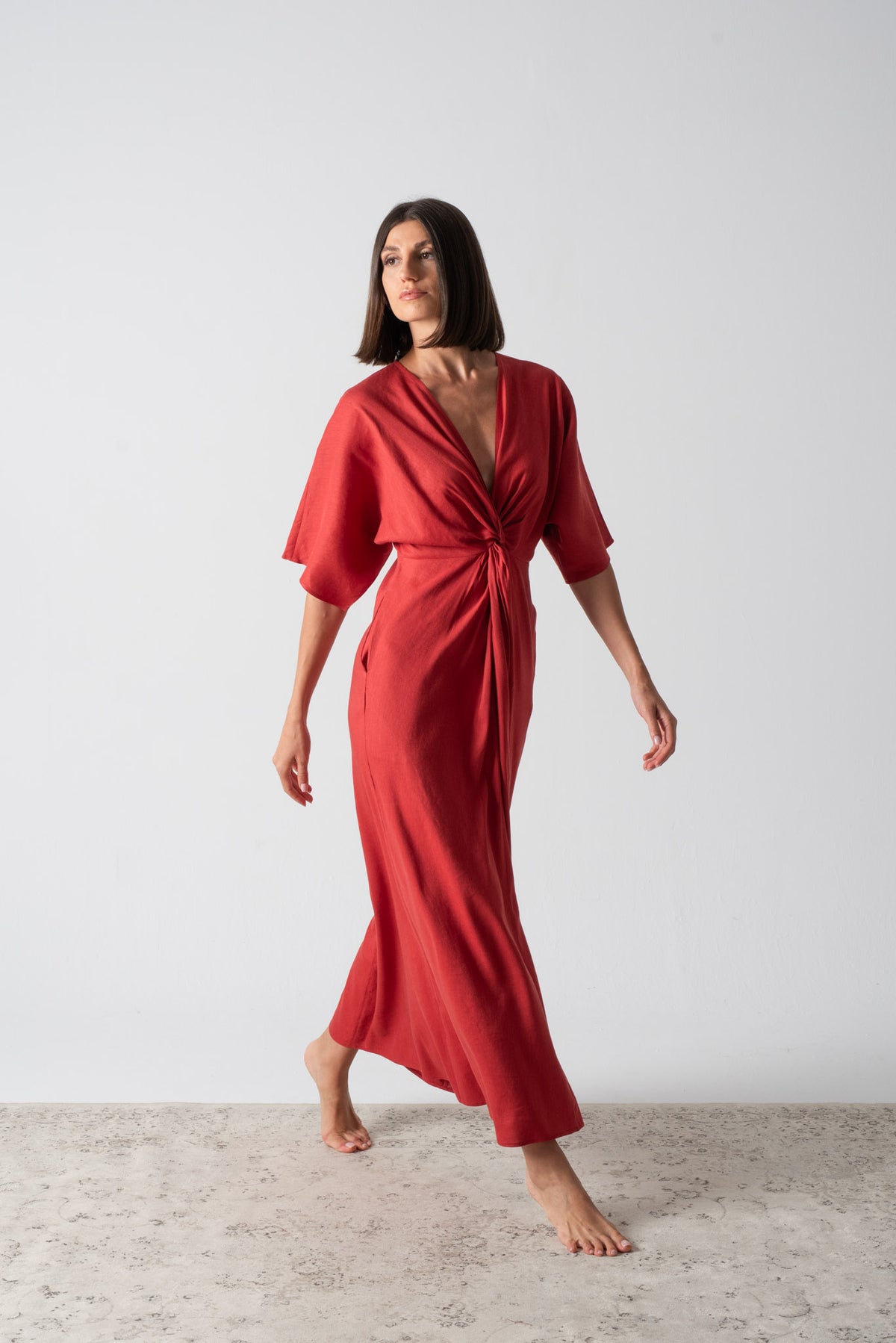
- Linen-elastane: just a touch, often as little as 1%, is enough to give a piece proper stretch and hold. It's what lets our Zulu Wrap Dress and Tuxedo Dress mould to a sculpted silhouette that 100% linen alone can't quite hold.
- Linen-polyester: ratios are all over the map, from a token splash of polyester added just to fight wrinkles, up to fabrics that are mostly polyester wearing a "linen-look" name tag. The more polyester creeps in, the less linen gets to actually be linen: less breathability, less natural cooling, less of the biodegradable thing we just talked about.
None of these are fake linen, to be clear. Some are a trade-off. Others, like a whisper of elastane for shape, are a deliberate choice.
It's a small amount of another fibre doing a job pure linen can't do on its own. Not a compromise, just good design.

What Is GSM, And Why Does Linen's Weight Matter?
GSM stands for grams per square metre, the standard way the textile industry measures how heavy or dense a fabric is.
The higher the number, the heavier and more substantial the fabric feels. A low GSM linen is light and airy. A high GSM linen carries more weight and structure.
Roughly speaking, lightweight linen sits around 100 to 150 GSM, ideal for breezy pieces from our linen tops collection and summer dresses that need to move and breathe.
Midweight linen, somewhere around 150 to 200 GSM, is the everyday workhorse. Enough body to hold a proper drape without feeling stiff.
Heavier linen, upwards of 200 GSM, holds its shape best. Think tailored linen trousers and structured pieces that need to keep a clean line rather than cling or crease as easily.
None of these weights are better than another, they're just suited to different jobs.
A wrap dress that needs to move with you wants a lighter hand, while a pair of trousers that needs to hold its shape benefits from a bit more weight behind it.
So if you've ever noticed some LUXMII pieces feel lighter and airier while others feel more substantial, that's the GSM talking, not a difference in quality.
It's worth knowing alongside the fibre content, right up there with checking whether a linen is 100% pure or a blend.
How To Tell What Your Linen Is Actually Made Of
Good news: you don't have to guess.
First stop, the fibre content tag: it's legally required to tell the truth about percentages, so trust that over anything printed on a garment tag or a product page.
Second, look for certifications like OEKO-TEX Standard 100, GOTS, or European Flax / Masters of Linen, which vouch for both what's in the fabric and how it was grown.
Curious what each of these actually guarantees? We break it down in why is linen so expensive.
Visually, real 100% linen usually has a bit of natural personality in the weave, small irregularities and slubs, so a "linen" that looks suspiciously smooth and uniform is worth a second look at the label.
Our own Hanne Trouser, for instance, lists exactly what you'd expect on the tag: 100% linen, sourced from European flax, nothing else along for the ride.
Purely as trivia, not a shopping tip: textile professionals actually identify fibres by burning a small snip of them, and it's the kind of fact that's oddly satisfying to know even if you'll never use it.
Natural cellulose fibres like linen scorch, then catch and burn quickly, with a smell like burning paper, leaving behind a small amount of soft, pale ash that crushes to nothing between your fingers.
Synthetic fibres do the opposite. They shrink away from the flame, melt and curl rather than properly burn, give off a sweet, chemical smell, and leave behind a hard little plastic bead that won't crush no matter how you try.
File that one under dinner party trivia, not a step in your shopping routine.
Before You Buy: The Quick Checklist
Standing in front of a rack or scrolling a product page, here's what's actually worth checking before you commit:
- Read the fibre content tag first. It's legally required to be accurate, so trust it over anything printed on the garment tag or the product page itself.
- Look for a certification. OEKO-TEX Standard 100, GOTS, or European Flax / Masters of Linen all vouch for what's actually in the fabric, not just what the tag claims.
- Check the weave for personality. Genuine 100% linen has small natural irregularities and slubs. A "linen" that looks perfectly smooth and uniform is worth a second look.
- Sanity-check the price. Real European flax linen costs what it costs. A "100% linen" piece priced like a polyester blend is usually one, whatever the tag says.
From Fibre To Fabric, Step By Step
Turning a flax stalk into something you'd actually want to wear is a proper process, and skipping steps, or rushing them, shows up in the final quality every time:
- Retting: the harvested stalks sit out in the field, or soak in water, for one to a few weeks while natural moisture and microbes quietly break down the woody outer layer. Too short and the fibres won't separate properly; too long and they come out weak or discoloured. It's a bit of a Goldilocks situation.
- Drying and breaking: once retted, the stalks dry out, then get mechanically cracked open to separate the good fibrous stuff from the brittle bark.
- Combing: the fibres get pulled through a series of combs, sorting them into long "line" fibres, destined for fine fabric, and shorter "tow" fibres, destined for coarser things like canvas.
- Spinning: the combed fibres twist into yarn. Longer fibre, finer and stronger thread. Simple as that.
- Weaving: finally, the yarn becomes fabric, usually in a plain, basket or damask weave depending on what it's growing up to be.
Even now, with all our technology, a fair chunk of this is still guided by hand rather than fully automated, which is exactly why linen is more costly.
We go even deeper on this whole process, plus how European production differs from the cheaper stuff, in what is flax linen.

Frequently Asked Questions
What is linen made of?
Linen is made from the fibres found inside the stem of the flax plant, Linum usitatissimum. These are a bast fibre, made almost entirely of cellulose along with natural pectin and lignin, which gives linen its strength, breathability and cool, crisp feel.
Where does linen come from?
Linen fibre comes from flax plants grown mainly in Western Europe, particularly France, Belgium and the Netherlands, which produce the finest quality fibre. China grows the largest volume of flax by weight, typically processed into coarser, lower-cost linen.
Is linen made from cotton?
No. Linen comes from the stem of the flax plant, while cotton comes from the seed head of the cotton plant. They are different fibre types from different plants.
What does 100% linen mean?
100% linen means every fibre in the fabric is flax-derived, with no other material blended in. This gives the fabric maximum breathability, faster softening and a longer lifespan compared to blends.
What is linen commonly blended with?
Linen is commonly blended with cotton for softness and lower cost, viscose or rayon for a smoother drape, a touch of elastane for structured stretch, and polyester for wrinkle resistance, though each blend gives up some of pure linen's breathability and durability.
What is GSM in linen fabric?
GSM, or grams per square metre, measures how heavy or dense a fabric is. Lightweight linen sits around 100 to 150 GSM and suits breezy shirts and summer dresses, midweight linen around 150 to 200 GSM works for everyday pieces, and linen above 200 GSM is heavier and better suited to structured, tailored garments.
Is linen a synthetic fabric?
No, linen is a completely natural, plant-based fabric made from flax fibres. It is biodegradable and unrelated to synthetic fibres like polyester or nylon, which are made from petroleum.
Conclusion: What Is Linen Made Of?
Consider yourself fluent in fibre now. The next garment tag you flip over won't stand a chance.
- Linen comes from the stem of the flax plant, a bast fibre, not a seed fibre like cotton, mostly grown in Western Europe and China.
- It's almost entirely cellulose, plus natural pectin and lignin that soften with every wash instead of wearing thin, and it's fully biodegradable when it's genuinely 100% linen.
- "100% linen" means no blending; common blends include linen-cotton, linen-viscose, linen-elastane and linen-polyester. Some trade away a bit of what makes linen linen for softness or price, others, like a touch of elastane, add something pure linen can't do alone, like structured stretch.
- GSM measures fabric weight, from light and airy shirting linen to heavier, structured suiting weights, and it's a matter of purpose, not quality.
- Checking the fibre content tag and certifications is still the fastest, most reliable way to know exactly what you're buying, whether that's a pair of linen pants or one of our linen dresses.